

2025/2026 Annual Savings Statement

Need help?

If you have any questions regarding your Annual Savings Statement, our FAQs could help you.

Need help?

If you have any questions regarding your Annual Savings Statement, our FAQs could help you.
Illustration of a contact centre employee

What's in your statement?

We aim for your statement to be simple and easy to understand. But in case you need a bit of extra information, here's an example of a statement with an explanation of what each section means.
Annual investor statement example

1.    Summary 

The total balance on your account(s) on 5 April 2026, and interest you have been paid from 6 April 2025 to 5 April 2026.
 

2.    Balance 

How much money is in the account on 5 April 2026, including interest that’s been added to the account.
 

3.    Interest

The total amount of interest paid for each account for the 2025/2026 tax year (between 6 April 2025 and 5 April 2026).


If it’s a joint account, we’ll tell you the total and also how much it would be for each account holder if it was shared equally.


If there is an odd number of pence, the extra penny goes to the account holder that has been a member the longest.
 

4.    Interest rate

The rate of interest for each account on 5 April 2026.
 

5.    Account

Account number, account name and for some accounts, your interest payment date.
 

6.    Account Holders 

The people named on the account. If someone was taken off the account before the date that interest was paid, or hadn’t been added before then, their name won’t show. 
 

7.    Closed Account

Any accounts closed between 6 April 2025 and 5 April 2026. 


8.    Offset

Your savings in this type of account are linked to your mortgage, to reduce the interest you pay. This is called the ‘Offset benefit’ and you’ll see it listed on your mortgage statements too.

9.    Total interest (excluding ISAs)

The total amount of interest paid on your non-ISA account(s) between 6 April 2025 and 5 April 2026.


You need to pay tax on any interest you earn above your Personal Savings Allowance (PSA); that’s £1,000 for basic rate taxpayers, £500 for higher-rate taxpayers and £0 for Additional rate taxpayers. For tax returns, you’ll need to let HMRC know how much interest you earned, so keep this statement safe.


For more information, contact HMRC or visit the HMRC website.
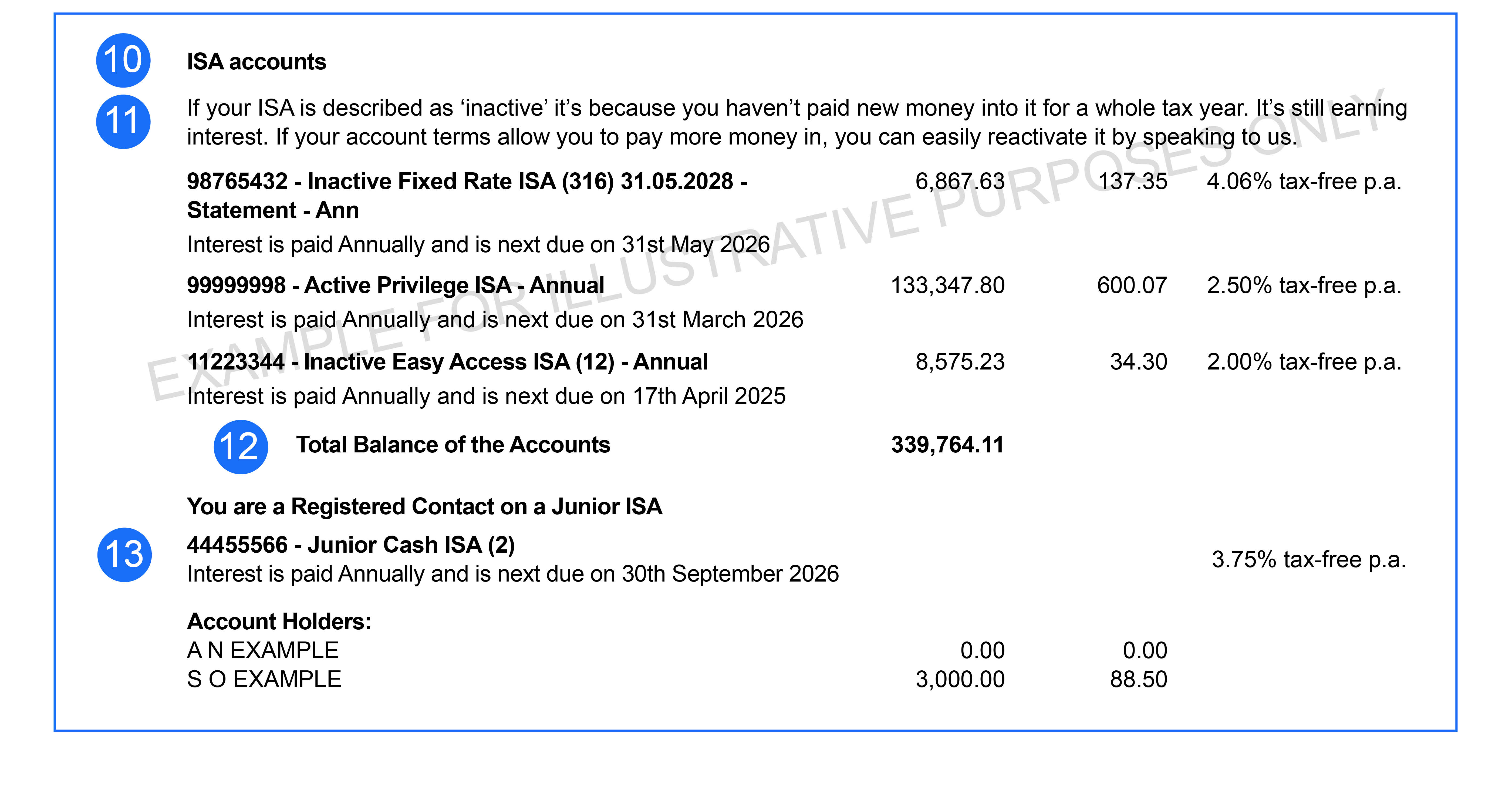
Annual investor statement example

10.    ISAs

ISAs are in a separate section because the interest they earn doesn’t count towards your PSA. This is because they're always tax-free.


Some of our ISAs are flexible. A flexible ISA means that you can take money out of your ISA and put it back within the same tax year without it counting further towards your annual ISA allowance, as long as you pay it back in before the end of the same tax year. The Specific Terms for your account will tell you if your ISA is flexible.
 

11.    Inactive ISA

If your ISA is ‘inactive’ it means you haven’t put any new money in it for a whole tax year. Any money in there is still earning interest. If your terms allow you to put more money in, you can reactivate it by getting in touch with us.
 

12.    Total balance of the accounts

This is the total amount of money in all the accounts (including ISAs) you hold with us on 5 April 2026.
 

13.    Junior Cash ISAs

If you’ve opened any Junior Cash ISAs they appear here. You may not have any other accounts with us so your own balance will show as zero. The money in any Junior Cash ISAs you’re a registered contact for doesn’t count towards your personal balance as it belongs to the child.

Annual Statement FAQs

Why is my balance different from what I was expecting?

Your Annual Savings Statement shows the balance in the account for all payments by 5 April 2026. Any payments made after this date will be included in next year's statement.

Why can’t I see how much is in the account?

If your name was taken off the account during the tax year, you’ll be able to see the interest but not how much is in the account. 

Why is there not as much interest as I was expecting?

Some accounts pay interest on a specific day each year. If your account is less than a year old, the interest may not have been paid when your statement was sent. Or it may be that the date happened before you’d had your account for a full year so it wasn’t a full year’s interest. Don’t worry, you’re earning interest every day you have money in your account. 

What is a flexible ISA?

A flexible ISA means that you can take money out of your ISA and put it back within the same tax year without it counting further towards your annual ISA allowance, as long as you pay it back in before the end of the same tax year. The Specific Terms for your account will tell you if your ISA is flexible.

Do I need to pay tax on the interest I earn?

Depending on your tax allowance, you may need to pay tax on any interest you earn over your Personal Savings Allowance. That’s £1,000 if you’re a basic rate taxpayer and £500 for higher rate taxpayers. If you do your own tax returns, you’ll need to refer to this statement and let HMRC know how much interest you earned. You don't pay tax on ISAs. Interest on ISAs is paid tax-free, that is without tax deducted. ISAs are a savings scheme initiated by the government, and are subject to change by them. For example the favourable tax treatment may not be maintained. There’s more information at www.hmrc.gov.uk

Why is my ISA described as ‘inactive’?

Your ISA shows as ‘inactive’ because you haven’t paid any new money into it for a whole tax year (that doesn’t include any money you took out of a flexible ISA and paid back in). Any money in the ISA is still earning interest. If you would like to pay in to your 'inactive' ISA you may be able to make it 'activate', allowing you to pay in. Call us for free on 0800 121 8899 for help.

Why isn’t the money in my Junior Cash ISAs included in the total balance?

The money in a Junior Cash ISA belongs to the child. As a registered contact the total balance will not show on your statement.

My Annual Savings Statement is incorrect

If you believe your statement is incorrect, get in touch by visiting any branch or call us for free on 0800 121 8899. We’ll be happy to go through your Annual Savings statement with you.

How does my Offset Savings Account work?

Your Offset Savings Account is linked to your mortgage, reducing the interest you pay. This is called the ‘Offset benefit’. It makes your monthly payments smaller or allows you to pay your mortgage off early. If the account balance is more than you owe on your Offset mortgage, you won’t get any benefit on the excess amount. If you don’t have money in your Offset Savings Account you won’t get any benefits either.

My account(s) interest rate and/or name has changed

We try to give you the best interest rate we can, which means we may need to increase or decrease the rate on your account depending on market conditions. Your account might also have been merged into a new product and now be called something different. We would have attempted to contact you to let you know at the time; please review and update your contact details if necessary. 

How can I get this information online?

We can send you your Annual Savings Statement online in the future if you’re registered for Online Services and we have an up-to-date email address for you. If you aren't registered you can do this online.

Any other questions?

If you have any other questions or would like help, get in touch by visiting any branch or call us for free on 0800 121 8899. We’ll be happy to help.

Savings help

Find help for all of your savings needs.

Compare savings accounts

Our tool helps you compare our accounts with those from other providers. That way, you can make an informed choice. 

Want help?
Our help section is bursting with useful information. If you'd rather chat, just give us a call.


Call us on 0800 121 8899

Lines closed
  • Mon-Fri 8am-7pm
  • Saturday 9am-2pm
  • Sunday & Bank holidays Closed
Call us

Want help?
Our help section is bursting with useful information. If you'd rather chat, just give us a call.


Call us on

0800 121 8899

Call us

Manage your cookies

We use three types of cookies to improve your experience. You can choose which optional cookies you’d like to allow below. We’ll save your preferences and apply them when you visit our site in the future. You can find out more in our Cookie Policy.

Essential cookies

Essential cookies are necessary for our website to work. They keep you secure, make sure pages load properly and enable basic features like navigation. These can’t be turned off.
Always active

Performance / analytics cookies

Performance cookies help us understand how you use our website, so we can make it better. They only collect anonymous data, like how long you spend on a page.

Advertising cookies

Advertising cookies help to show you ads that match your interests. They’re managed by trusted third parties so you should only see things that are relevant to you.